
Finding a lump or bump on your pet can stop you in your tracks. You may notice something new while giving your dog a belly rub or discover an unusual growth during a grooming session, and the uncertainty that follows can feel unsettling. Is it serious? Does it need to come off right away? Can it wait? These are questions our veterinary team hears often, and they deserve clear, honest answers. When it comes to masses on pets, not all lumps are created equal, and understanding the difference is key to making the best decision for your companion.
At Stonebridge Veterinary Wellness, our lumps-and-bumps screening and treatment services are an important part of the proactive, personalized care we provide to pet families in Roseville, Rocklin, Lincoln, Granite Bay, Citrus Heights, and surrounding areas. As a family-owned veterinary practice, we bring our extensive experience and a genuine commitment to transparency to every evaluation, and our team is here to help you feel informed at every step.
Why a Lump Should Never Be Dismissed
One of the most common misconceptions pet owners encounter is that a lump must look or feel a certain way to be worth addressing. In reality, no veterinarian can reliably determine what a mass is, based solely on its outward appearance. A soft, movable lump might be a harmless fatty deposit, while a similar-feeling growth in another location may warrant prompt attention. Appearance alone simply cannot tell the whole story, which is why professional evaluation matters.
Even masses that seem small or stable can change over time in ways that are not visible from the outside. Keeping up with preventative care and routine wellness visits allows our veterinary team to track any changes, compare findings across appointments, and make evidence-based recommendations before a situation becomes more time-sensitive.
Common Types of Masses in Pets
Pets can develop a wide range of masses, and many of them are benign. Lipomas, which are soft, fatty growths, are among the most frequently seen in older dogs and tend to grow slowly without causing discomfort. Sebaceous cysts and warts are also relatively common and may remain stable for long periods. In younger dogs, especially, histiocytomas are a type of growth that may sometimes regress without intervention.
That said, not every mass is harmless. Mast cell tumors are among the more common malignant growths found in dogs and can closely resemble benign masses, making professional evaluation essential. Soft tissue sarcomas and mammary tumors, particularly in cats, may also require more immediate attention. Because a mass’s external characteristics can be misleading, our veterinary team relies on diagnostic tools rather than guesswork to give you accurate information. Older pets are at a higher risk of developing masses, and senior pet care visits are a perfectnatural time to have any new or existing growths reviewed.
Signs That May Call for Prompt Evaluation
While some masses can be monitored safely over time, certain characteristics may indicate that a closer look is needed sooner rather than later. Our veterinary team generally recommends bringing your pet in if you notice any of the following:
- Rapid growth or a noticeable change in size over a short period of time
- Changes in the mass, including ulceration, bleeding, or discharge
- A hard or fixed texture that does not move freely beneath the skin
- A location near the face, joints, or limbs where growth may affect your pet’s movement
- Signs of discomfort, such as licking, biting, or sensitivity around the affected area
When in doubt, having a mass evaluated early can open up more treatment options and help you feel confident rather than anxious about your pet’s health.
How Masses Are Evaluated and Treated
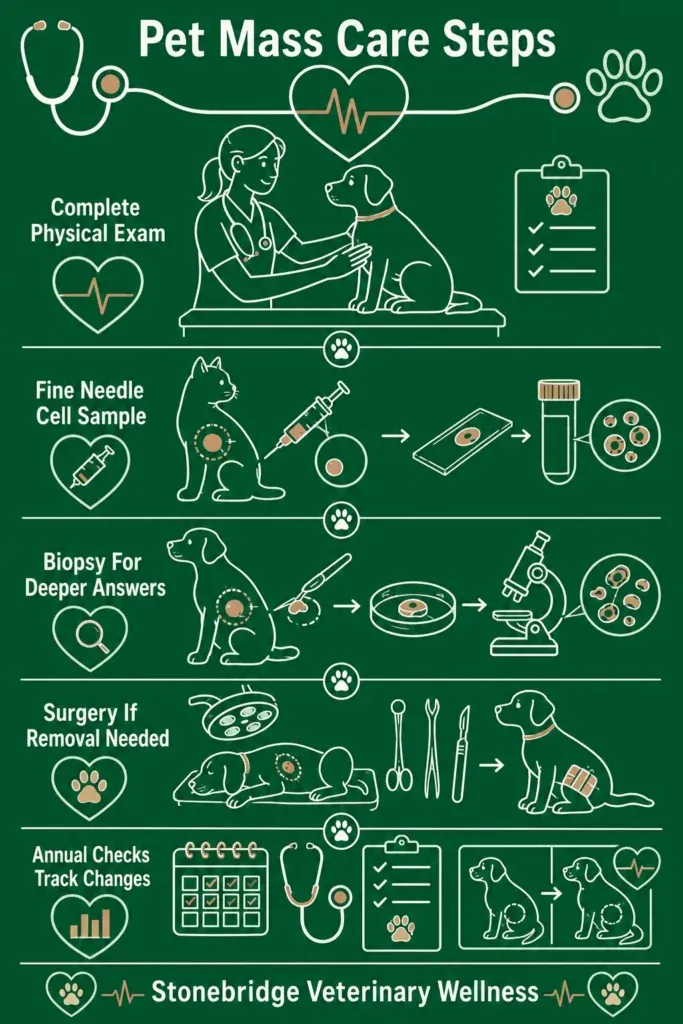
When you bring your pet in for a mass evaluation, our team begins with a thorough physical exam. In many cases, a fine-needle aspirate may be recommended, a minimally invasive procedure in which a small sample of cells is collected from the mass and analyzed. Veterinary specialists recognize fine-needle aspiration as an effective, low-risk first step, because a definitive diagnosis cannot be reached by appearance alone. For masses that need more detailed analysis, a biopsy may also be considered.
At Stonebridge Veterinary Wellness, our team performs numerous mass removals, and our oncologic surgery services are available for pets whose growths require surgical intervention. An annual wellness checkup is also a perfectnatural opportunity to have any existing or newly discovered masses assessed and documented so our team can track changes over time.
Stonebridge Veterinary Wellness Has Answers for Your Pet’s Lumps and Bumps
At Stonebridge Veterinary Wellness, our veterinary team takes lumps and bumps seriously because we understand how much your pet means to you. As a family-owned practice serving pet families in Roseville, Rocklin, Lincoln, Granite Bay, Citrus Heights, and surrounding areas, we bring our extensive experience to every mass evaluation. Our doctors perform numerous mass removals and work with an outside laboratory when more comprehensive testing is needed, so that every recommendation we make is grounded in accurate, detailed information. When it comes to your pet’s health, you deserve honest guidance from a team that genuinely cares.
If you have noticed something new or have been monitoring an existing growth, you do not have to figure this out alone. We encourage you to contact our office to speak with one of our doctors, ask your questions, and take the next step toward peace of mind for both you and your pet.
